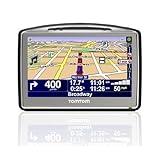
I own and actually have used (each, during thousands of miles of auto travel) a Lowrance iWay 350, Garmin 60Csx handheld, Garmin Nuvi 200, Magellan Maestro 4040, a 2007 Chrysler OEM in-dash navigation unit, and now a TomTom 720.
The TomTom 720 is one cool unit. I just finished a 4000 mile cross-country test trip. It has features that stand out: Blazing fast satellite acquisition, as instant as the superb Garmin Nuvi 200; a status bar that is complete (with variables such as ETA, Distance to Destination, Time to Destination, Time of Arrival, current time, and current speed) and is customizable as to map screen location and data inclusion/exclusion. I consider the status bar an important feature of any auto GPS and never have understood why the Magellan and Garmin units lack key trip data displays on their map screens. Perhaps it is a design consideration by these makers in weighing Highway use versus City Driving use. I suspect most GPS units are bought and used by local-area drivers with little need for these trip data.
The TomTom720 graphics are as colorful and bright as the Gamin Nuvi series' with one additional feature: superb highway interchange and exit graphics that actually depict bridges (driving under overpasses!) and all surrounding ramps. The TomTom features the best highway ramp information and guidance of any unit I have used (above). The excellent 3D graphics' flow is smooth, and doesn't digitally blotch up going around curves. The graphics are simply superior. By the way, voice guidance is detailed, suitably anticipatory, and redundant, again superior to any of the other brands I have used.
TomTom routing was generally excellent. Only one time did the unit get confused about the location of a segment of Highway 80 in Wyoming, which did appear to recently have been resurfaced and perhaps relocated. The Garmin Nuvi 200 ranks absolutely last (of all my units) on routing, constantly recalculating a route that should have been and is a straight interstate highway shot. This to me indicates out-of-date maps. In the Garmin Nuvi 200 there is no way to stop the constant rerouting in these instances.
Finally, the menus and POI's. The TomTom 720 suffers from too many layers of menus for routine items (brightness of screen, for example). The menu items are somewhat confusing as well. The POI's are adequate, their listings complete. Although the POI's on the Magellan unit, whose database is tied to AAA information, was far superior; and in fact the entire POI feature set of the 4040 is superior to that of any unit listed here. Unfortunately, my Magellan Maestro 4040 crapped out after 10 hours use.
The TomTom unit has one of the fastest and easiest to use address-find systems. And, its calculation and routing computational feature is very quick and robust. Certainly, it is as quick as the Garmin Nuvi unit which is also lightning fast.
I do not and did not use or test any of the Bluetooth and MP3 features. To me, their inclusion is feature bloat.
After I attached my unit to the internet and to TomTom Home, it automatically updated current software and MapShare information to my unit, although it is difficult to determine from the download what was actually corrected, if anything. MapShare is not a web site as you might think, but merely an upload process descriptor, and the user data are apparently treated and vetted by TomTom in some manner before actually being broadcast downloaded to all users who ask for the corrections (you can opt out or in a number of ways).
I found the speedometer readout on the map screen very useful, because on my return trip I had switched to snow tires that were 65R18 instead of the specified 60R18. This resulted in an erroneous odometer reading that was actually too high since the tire was rotating too many turns per mile for the car`s computer setting. As a result, I was driving too fast and not knowing it; I slowed down a couple of miles per hour from 75 to 73 (as indicated on my odometer) until the TomTom read 75. I would never have realized this problem without the speedometer readout on the TomTom. This feature probably saved me a speeding ticket or two.
Negatives: Compared to the Nuvi series, which I consider among the best of the units I own, diminished only by the constant and annoying rerouting during highway driving, the fonts on the map screen of the TomTom are small and wording can be somewhat hard to read, especially considering the short mount provided. (Buy an optional longer windshield mount to bring the unit closer.)
More troubling is the algorithm that computes Time to Arrival (therefore 4 stars). The TomTom 720 was consistently 15% higher on estimated Time to Arrival, compared to all of the units above, except the Magellan 4040, which was about 5% high. These numbers are based on a trip that is standard for me and whose distance and time I have verified many times with actual numbers. The TomTom's displayed Distance to Destination (miles) figure, however, was spot on with the actual distance traveled. It should be noted, that just like the Magellan 4040, the TomTom will shorten up its Time to Arrival as you approach your destination. So, at your destination both units will read accurately (that is, show no time remaining).
All in all, if you don't do a lot of long distance driving then the overstated times are of little concern. Then, the TomTom 720 should be among your top choices for a vehicle GPS unit. TomTom got it mostly right. Now if only it would automatically display the correct time for whatever time zone you are driving through. Still, the TomTom 720 is the very best of all of the GPS units I own or have used.
Update: Yesterday, December 24, 2007, I completed a 600 mile roundtrip to the Monterey, CA area, typically a five to five and a half hour trip one way (elapsed time, no stops added in). The 720 indicated this would be a 7 hour trip, an estimate 30%-40% high. It turned out to be a 5 hour 45 minute trip with a gas stop. At the midway point (150 miles) it was estimating three and a half hours. However, as we got closer to home, the time of arrival approached the actual time.
Perhaps I am too obsessive about trip computer data, but the other GPS units cited above seem to get it right and, frankly, it frustrates me on long drives.
Also, the 720 designed a route that called for traveling through the East Bay to get to US 101, and I usually take Interstate 280 and the Golden Gate Bridge. Unfortunately the 720 would not let change routes on the fly, and even though it recalculate routes very quickly it called for me to get off at every exit on 280 and head east, losing hours in the process. The 720 finally stopped reroute directions and calculations after I passed over the Golden Gate and was back on US101.
Get more detail about TomTom GO 720 4.3-Inch Widescreen Bluetooth Portable GPS Navigator.


No comments:
Post a Comment