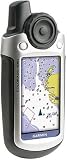
I just got one of these for an over-water trip that I'm planning next week. This is my first GPS, so I didn't have any preset expectations. My requirements were reasonable waterproof performance (i.e., lives up to the claimed IPX7 standard), can operate continuously in all conditions for more than 12 hours and that the interface is easy to use.
Prior to purchasing this model, I did make myself aware of some pretty loudly-stated drawbacks, including the ill-fitting battery cover (more on that below), incidents involving water damage and the "battery hog" reputation (with some supporting tests). I also considered the GPSMAP 60 CSX, but figured that the screen wasn't quite large enough to be easily legible during vigorous activity - bigger is better!
Upon receipt, the first thing I did was inspect the water sealing - and I was somewhat disappointed at the design. It's probably cheap to manufacture, but I would have gone in a different direction. Basically the battery cover squeezes down on two o-rings; one around the batteries themselves and one around the SD card slot. I've seen others say that the cover fits better without the SD card slot o-ring, which is just about the dumbest performance-related design comment I've heard about this device. Without that o-ring, the device is no longer capable of being submerged.
The main problems with this design are two-fold: first, stress on the battery cover, which is the main attachment point for clips, mounting brackets etc. could deform the cover and thus pull it away from its pressured contact with the o-rings. This is bad, but not a disaster so long as the o-rings are in good condition. The second issue is that the main o-ring around the batteries is subjected to shearing every time the cover is removed; this is a recipe degradation over a very short period of time without preventative measures.
Clearly Garmin didn't think this through carefully. What I did was apply a fairly generous coating of silicone grease to the o-rings, improving their contact with the cover, and lubricating them so that the main one in particularly will slid against the battery cover with significantly less wear. I believe that this will extend the water resistance of this device substantially beyond the base design, and haven't been able to think of any other reasonable solutions. The top flap that protects the USB port is another problem area, and I don't have an answer there. Again, a problematic design choice.
Garmin has a "beta" case design here. If they redesigned it JUST A LITTLE bit, it would be absolutely phenomenal.
In any case, after greasing up the case, I hosed down the unit thoroughly, which is very abusive because it forces water into it, and then dunked it in a bucket (about 1.5' deep) for about 30 minutes. As you might guess from the 4-star rating, it still works great! However, it can't lock on to the satellites while under water, which is fine because I won't be using this to navigate whilst scuba diving.
With respect to the interface, the controller is actually fantastic - very easy to get around, works well with gloves etc. Touch screens just don't work in all environments, and this controller is better than buttons. If you could program the soft keys (maybe you can?) it'd be even better. However, the waypoint configuration capability on-device flat-out sucks. Why can't you enter lat-long data by number? That's b.s. You might be able to, but I haven't figured it out yet - and the manual is completely worthless. It's really too bad, because this is obviously a powerful device. It's like the engineers came up with a great interface, and then forgot to write down how it works.
Finally, to test battery life - and keep in mind that this is a recent buy - I put in some lithium batteries (before dunking it in the bucket!) and turned the screen on, WAAS - everything - and frequent redraws because I've been fooling around with it all day. So far, 16 hours later, I'm on 4-out-of-4 bars. I did load the newer software (3.4 for the device / 2.9 for the GPS chipset) so maybe that helps, I don't know. And maybe it just likes Lithium. The upshot is that this will work on one set of batteries for a long run of continuous operation.
I'll update this review if things turn out differently (e.g., if water gets in, battery life somehow changes for some reason etc.).
If Garmin would have done a better case design and actually included some documentation this would be a "must buy" product for people who need GPS.Get more detail about Garmin Colorado 400c Portable GPS System with Preloaded Coastal Waters Maps.


No comments:
Post a Comment